
Financial risk
The chance of an investment's actual return being different than expected. Trading the financial markets is, effectively, the trading of risk.
Module 05
Before any strategy, before any indicator — define risk, understand what amplifies it, and learn the small set of rules that keep traders in the game.
Let's not get ahead of ourselves. Before talking about how to manage risk, make sure you understand what risk truly is.
Risk is uncertainty — the chance of an outcome being different than expected.
The chance of an investment's actual return being different than expected. Trading the financial markets is, effectively, the trading of risk.
By buying EUR/USD you effectively believe the Euro will strengthen against the US Dollar. The risk is the possibility of the opposite — the Euro weakening — an adverse move.
Financial risk is the possibility of losing part or all of your original investment.
Although risk makes you susceptible to adverse moves, risk is also what creates the opportunity for sizeable returns. No risk, no reward.
The higher the risk an investor takes on, the higher the potential return must be to compensate for it.
Several factors influence how much risk a trade carries. Three matter more than any others.
Higher leverage = more risk = larger profit potential.
Leverage lets you control a relatively large position for a fraction of its cost — magnifying both profit and loss. A 0.25% margin requirement, for example, is 400× leverage: $250 controls $100,000 in market exposure.
Higher volatility = more risk = larger profit potential.
Volatility is the size of price changes over time. High volatility means prices can swing dramatically in either direction over short periods — opportunity and danger in equal measure.
Emotion is the most underestimated source of risk.
Trading is far more emotional than it looks. Fear and greed inflate implied volatility, hope keeps you in losing trades, and a bad mental state distorts every decision. Covered in depth in the next module.
Stop loss orders are the single most important risk management tool — and should always be in place when trading.
Executed at the point where gains equal losses — locking in a no-loss outcome on a trade that has moved in your favour.
Rely on a certain period of time elapsing before the order is executed — useful when a thesis hasn't played out within its expected window.
Set at a percentage below the market price and ratchet with it. They let profits run while quietly capping the downside.
Learn to love your losses, manage your losses, and learn from your losses — or one day a loss will wipe out your entire account.
Your trading style will define how low or high risk your strategy is — but even the greatest strategy is of little help if you don't control risk.
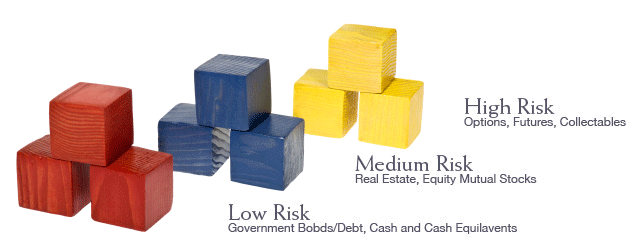
Potential low return.
Potential medium return.
Potential high return.
Risk tolerance is the degree of uncertainty you can handle about a potential loss or decrease in your portfolio. It differs from person to person and generally depends on three things.
Your personal income and situation. A person on a low salary about to get married will typically have a lower risk appetite than a single person on a medium salary.
How long you plan to keep your money invested. Longer time horizons are associated with less risk than shorter ones.
The greater your financial goals, the greater the risk you will likely need to take on to reach them.
Asset allocation is an investment strategy that shares your portfolio between asset types according to your goals, risk tolerance and time horizon. Different allocations carry different levels of risk.
A risk management technique that reduces risk by mixing many different investments. It is particularly useful against unsystematic risk — the industry- or company-specific kind.
The lower the correlation between investments, the lower the risk overall — bad performers can be offset by good ones.
Gold is inversely correlated to the dollar — as the dollar weakens, the value of gold tends to appreciate.
Rising crude oil prices tend to lift gold, as gold is often bought as a hedge against the inflation oil prices imply.
Leverage can be tailored. If you're risk averse, trade on higher margin requirements to reduce leverage. Treat margin like a credit card — don't get carried away with money you don't have.
| Margin requirement | Leverage | Risk level |
|---|---|---|
| 0.5% | ×200 | High risk |
| 1% | ×100 | — |
| 3% | ×33.3 | — |
| 10% | ×10 | — |
| 20% | ×5 | — |
| 50% | ×2 | — |
| 100% | No leverage | Low risk |
Use it to time entries and exits, identify support and resistance, place strategic stop losses, spot trends and patterns, and build risk parameters from indicators. All of this lowers risk and improves your chances of profit.
A stop loss — a preset level that closes a trade automatically — limits downside and reinforces discipline. In very volatile markets be aware of slippage and gaps: the first available price after a gap can be well past your stop, sometimes producing a loss larger than the initial deposit.
Margin is one of the great advantages of CFD trading, but every margin trade should consider how much capital sustains the position. A common rule: no single position should risk more than 5% of available capital. In volatile conditions, halve your normal size.
Volatile markets mean high volumes and possible execution delays. Spreads may widen and some market makers temporarily withdraw prices. In high-volatility windows it is sometimes better to limit trade execution altogether.
In volatile periods it's easy to be shaken from a strategy that works in calm ones. Experienced traders apply the same investment process they normally do — short-term moves are nearly impossible to predict; long-term discipline isn't.
Plan your work and work your plan.
Open a live account in minutes. Local MENA support, regulated execution, and competitive spreads.